Studios
How to open a pilates studio in Saudi Arabia, step by step
An owner’s walkthrough from the first concept decision to opening week: licences, space, equipment, instructors, pricing and the systems that run the front desk.
· 8 min read
Book a class
Today · Tue 10
Schedule
7:00 AM
50 min
Reformer Flow
8:30 AM
50 min
Mat Pilates
6:00 PM
50 min
Barre
7:30 PM
50 min
Reformer Sculpt
Reformer Flow
Tue 10 · 7:00 to 7:50 AM
with Noor
Senior instructor
2 of 12 spots left
Uses 1 credit · 7 left
See you at 7:00 AM
Reformer Flow with Noor
Credits left in your package
You're off the waitlist
Mat Pilates 8:30 AM is confirmed
Key takeaways
- Opening a pilates studio in Saudi Arabia takes a commercial registration, a Ministry of Sport licence for a private sports centre, a municipal licence through Balady and Civil Defence approval, in that rough order.
- Decide reformer or mat, group or private, and mixed or women-only before signing a lease, because the concept sets the floor plan, equipment budget and pricing.
- From 18 November 2026, private sports centres with four or more workers must reach 15% Saudization across the listed professions, which include sports coaches and personal trainers.
- Reformer capacity is fixed by the number of machines, so revenue depends on pack and membership design and on keeping every booked spot filled.
- Have online booking, local payment methods, e-invoicing and WhatsApp reminders running before opening day, so founding members book and pay without staff in the loop.
How do you open a pilates studio in Saudi Arabia?
How to open a pilates studio in Saudi Arabia comes down to six steps. You choose a concept, register a company with the Ministry of Commerce, license the studio as a private sports centre with the Ministry of Sport, obtain a municipal licence through Balady and Civil Defence approval for the premises, then fit out the space, hire certified instructors and set up booking and payments. Most of the real work sits in the order of these steps, because each approval depends on the one before it.
- Concept: reformer or mat, group or private, mixed or women-only.
- Company and licences: commercial registration, Ministry of Sport, municipality, Civil Defence.
- Space and equipment: floor plan, flooring, changing rooms, reformers and props.
- Team: certified instructors, a front-desk lead and a Saudization plan.
- Commercial setup: pricing, class schedule, booking, payments and e-invoicing.
- Launch: founding members, a waitlist and a soft opening week.
Rules are changing in 2026
Saudi Arabia approved a unified Sports Law by Royal Decree M/121, and it entered into force in 2026. Entities have one year from entry into force to bring their status in line, and implementing rules and licensing procedures may change as the Ministry of Sport issues them. Treat the steps below as the current path as of October 2026 and confirm each one with the authority before you pay fees or sign a lease.
Step 1: Choose your concept (reformer or mat, group or private)
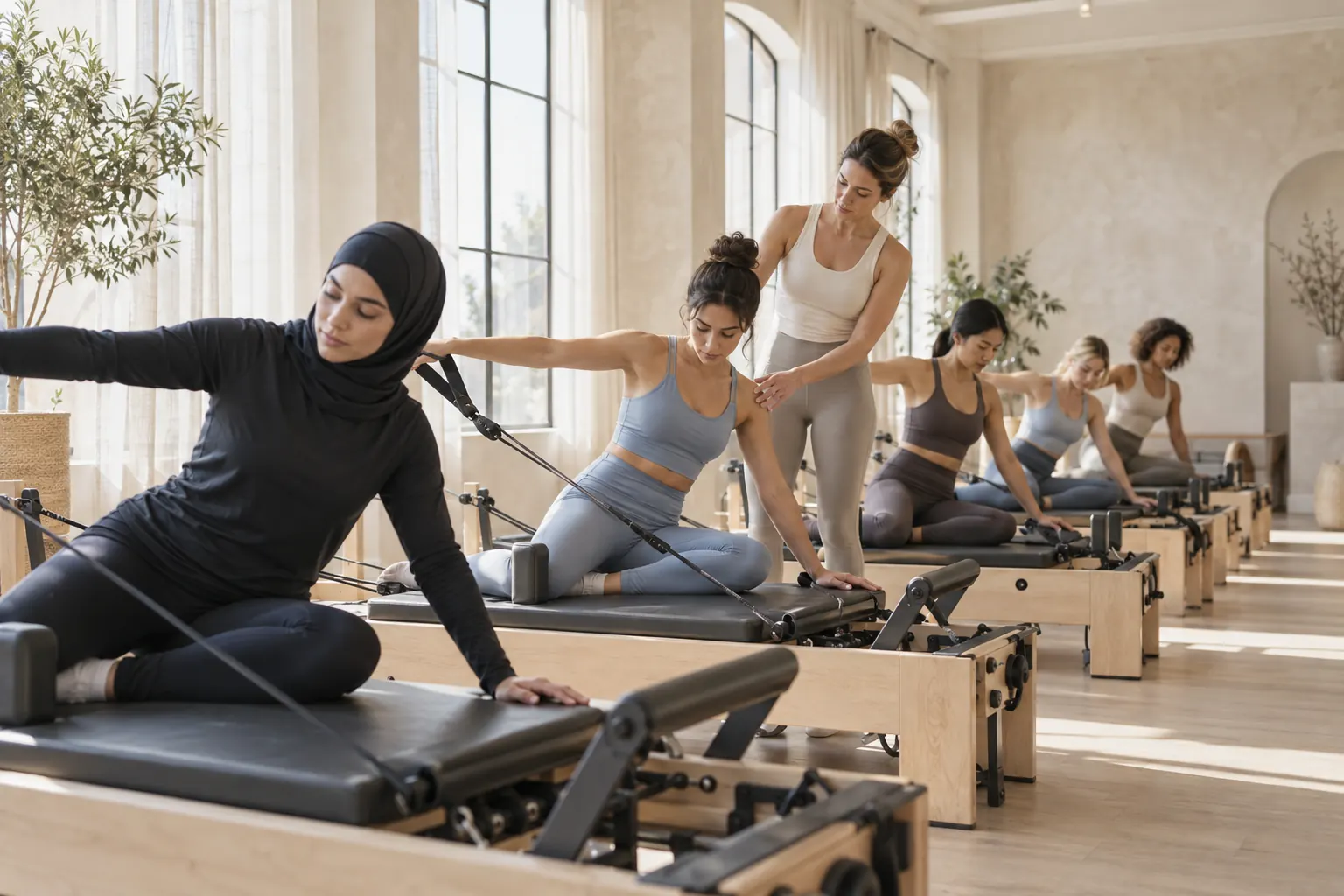
The concept decides almost every number that follows. A reformer group studio needs one machine per client in every class, so the room size and equipment budget cap your capacity from the start. A mat studio needs far less equipment and can run larger classes, but it usually commands a lower price per class. Private and duet sessions on reformers, towers and chairs earn more per hour and need instructors with comprehensive training.
| Format | Equipment | Capacity driver | Instructor profile |
|---|---|---|---|
| Reformer group | One reformer per client, plus props | Number of reformers in the room | Reformer or comprehensive training |
| Mat group | Mats, small props, optional wall units | Floor area per mat | Mat training |
| Private and duet | Reformer, tower or Cadillac, chair, barrels | Instructor hours available | Comprehensive training |
| Hybrid | A reformer room plus a private studio | Both rooms, scheduled separately | A mix of both profiles |
Many Saudi studios open as ladies-only or run women-only hours. That choice affects more than marketing. It shapes the entrance and reception layout, privacy of the studio from the street, changing rooms, and which instructors you recruit. If you plan a women-only studio, ask the Ministry of Sport and your municipality early whether specific design or operating conditions apply to your premises.
Step 2: What licences does a pilates studio need in Saudi Arabia?
Start with a commercial registration from the Ministry of Commerce, with an activity that covers operating a sports or fitness centre. The studio then needs a licence from the Ministry of Sport, which has licensed private clubs, academies and gyms through its Nafes platform since 2021. Pilates studios generally fall under the private sports centre or fitness centre category. Confirm the exact activity name on the platform, because categories may be updated under the new Sports Law.
- Commercial registration: Ministry of Commerce, with the right business activity.
- Sports centre licence: Ministry of Sport, through the Nafes platform.
- Municipal commercial licence: Ministry of Municipalities and Housing, through Balady, tied to your lease and location.
- Civil Defence licence: safety approval for the premises, issued through the Salamah service.
- Tax: VAT registration with ZATCA once you cross the threshold, and e-invoicing from then on.
Choose the unit before you commit to it. The municipal licence depends on the building’s permitted use, and Civil Defence checks fire safety, exits and occupancy, so a cheap unit in the wrong building can cost months. On tax, ZATCA requires VAT registration once taxable supplies exceed SAR 375,000 over 12 months, with voluntary registration available above SAR 187,500. Fees and documents change, so confirm each step with the authority or a licensing adviser.
Step 3: Location, floor plan and pilates studio equipment list
Plan the floor around the reformer room. Each reformer needs its own footprint plus walking space on both sides so the instructor can reach every client, and the room needs storage for boxes, jump boards and props. Allow for a reception area where clients wait without crowding the studio, changing rooms with lockers and showers, and a quiet room if you plan private sessions. Good ventilation and a sound floor matter more than finishes.
- Reformers: one per spot in your largest group class, plus one spare if budget allows.
- Tower or Cadillac: for private sessions and rehabilitation-style work.
- Chairs and barrels: Wunda or stability chair, ladder barrel, spine corrector.
- Reformer accessories: sitting boxes, jump boards, platform extenders.
- Small props: mats, rings, balls, light weights, bands, foam rollers.
- Front of house: lockers, cleaning supplies, a sound system and a tablet or screen for check-in.
Prices vary widely by brand, model and import route, so collect written quotes rather than relying on averages. Ask each supplier about delivery lead time to your city, installation, local servicing, spare springs and ropes, warranty terms and how quickly a broken machine can be repaired. A reformer out of service removes a paid spot from every class until it is fixed.
Step 4: Hire certified instructors and plan for Saudization
Clients judge a studio by its instructors. Widely recognised international programs include BASI Pilates, STOTT PILATES from Merrithew and Balanced Body, each offering mat, reformer and comprehensive tracks. Comprehensive certification covers the full apparatus range and suits instructors who will teach private sessions. Ask candidates for their certificates, verify them with the issuing body where possible, and run a paid audition class before hiring.
Build Saudization into your hiring plan from the start. The Ministry of Human Resources and Social Development, with the Ministry of Sport, set a 15% localisation rate for 12 professions in private sports centres and gyms, for men’s and women’s facilities. It applies to establishments with four or more workers and takes effect on 18 November 2026. The listed professions include sports coach, sports supervisor and private sports coach, and the full list is in the ministry’s procedural guide.
Plan the team before the count
A small studio crosses four workers quickly once you add reception and cleaning staff. Recruit and train Saudi instructors early, and check the Human Resources Development Fund (Hadaf) programmes the ministry points to for recruitment and training support. Our Saudization guide covers how the percentage is counted.
Step 5: Set pricing, the class schedule and your booking stack
Start the pricing model from capacity. Multiply reformers by the classes you can staff each week to get sellable spots, then decide how you sell them: drop-ins, class packs with expiry windows, monthly memberships, intro offers and private sessions. Each model changes cash flow and retention differently, which our guide on class packs vs memberships walks through. Price from your cost per class hour and target occupancy, rather than copying a competitor’s menu.
Build the timetable around when your clients are free. Early mornings, late afternoons and evenings usually fill first, so test midday classes with fewer slots before adding more. Publish a cancellation window and a late-cancel rule on day one, because fixed reformer capacity makes every empty booked spot a real loss. A waitlist that offers freed spots to the next client recovers part of that loss.
- Booking: a branded booking page and app where clients see live availability.
- Payments: mada, Apple Pay and cards through a licensed payment gateway.
- Packs and memberships: balances that draw down on attendance and expire on schedule.
- E-invoicing: a compliant invoice for every paid class, pack and membership.
- Messaging: WhatsApp confirmations and reminders in Arabic and English.
Decide early whether clients book on your own system or through a shared class marketplace. Marketplaces can fill spare spots, while your members, packs and peak hours are usually better kept on a system under your own brand. Our marketplace guide explains that tradeoff.
Step 6: Pre-opening checklist and launch marketing
| Item | Done means | When |
|---|---|---|
| Licences | Ministry of Sport, municipal and Civil Defence licences issued and displayed | Before any paid class |
| Equipment | Reformers installed, tested and covered by a service contact | Two to three weeks before opening |
| Team | Instructors hired, certificates on file, Saudization plan in place | Four weeks before opening |
| Policies | Cancellation, late-cancel, expiry and refund rules published | Before sales open |
| Systems | Test booking, payment, refund and e-invoice completed end to end | Before sales open |
| Launch list | Waitlist contacts collected with consent to message them | From the day you sign the lease |
- Founding memberships: a limited number at a launch rate, with clear terms on how long the rate lasts.
- Pre-launch waitlist: collect names and numbers from a simple form during fit-out.
- WhatsApp: tell the waitlist first when sales open, from your own business number.
- Instagram: show the fit-out, introduce instructors and post the opening timetable.
- Soft opening week: free or discounted taster classes for friends, family and local partners.
An intro offer limited to first-time clients converts curiosity into a first visit without discounting your regulars. Follow up after the first class with a clear next step, such as a starter pack or a founding membership.
How AskFlow handles this
AskFlow runs the commercial side of a studio on its own brand: a booking page and optional branded iOS app, class schedules with waitlists, class packs with expiry windows, packs limited to first-time clients, memberships with member pricing, and mada, Apple Pay and card payments through licensed gateways. Every paid pack, class and membership generates an e-invoice through your accounting system, and confirmations and reminders go out on the official WhatsApp Business API in Arabic and English.
We set it up with you before opening, including your pack rules, cancellation windows and class templates, so the first founding member books and pays on day one.
Common questions
Do I need a Ministry of Sport licence to open a pilates studio?
Yes. A pilates studio that sells classes to the public operates as a private sports or fitness centre, which the Ministry of Sport licenses through its Nafes platform. You also need a commercial registration, a municipal licence through Balady and Civil Defence approval. Confirm the current category and documents on the platform, since the 2026 Sports Law may change procedures.
How many reformers does a new pilates studio need?
You need one reformer for every spot in your largest group class, and the right number depends on room size, walking space between machines and how many classes you can staff. Many owners start with the number the room fits comfortably, then add a private room with a tower and chair later. A spare machine protects capacity during repairs.
Which pilates certifications should instructors have?
Widely recognised international programs include BASI Pilates, STOTT PILATES from Merrithew and Balanced Body. Each offers mat and reformer tracks and a comprehensive track that covers the full apparatus range. Group reformer instructors need at least reformer training, while private sessions on towers and chairs call for comprehensive certification. Verify certificates with the issuing body where you can.
Does Saudization apply to pilates studios?
From 18 November 2026, private sports centres and gyms with four or more workers must localise 15% of 12 listed professions, in both men’s and women’s facilities. The list includes sports coach and private sports coach roles. A pilates studio licensed as a sports centre should check its staff against the ministry’s procedural guide and plan Saudi hires early.
Can I open a women-only pilates studio in Saudi Arabia?
Yes, many studios in the Kingdom operate as ladies-only or set women-only hours. The choice affects your entrance, reception, privacy from the street, changing rooms and staffing. Ask the Ministry of Sport and your municipality early whether specific design or operating conditions apply, and select the matching category when you apply for your licence.
What should be ready before a pilates studio opens?
Have all licences issued, reformers installed and tested, instructors hired with certificates on file, and cancellation, expiry and refund rules published. Run a test booking, payment, refund and e-invoice from start to finish. Then open sales to your pre-launch waitlist first, with founding memberships or an intro offer limited to first-time clients.
Sources
- Ministry of Human Resources and Social Development: Saudization of professions in sports centres and gyms (opens in a new tab)
- Umm Al-Qura: Royal Decree M/121 approving the Sports Law (opens in a new tab)
- ZATCA: What is e-invoicing (opens in a new tab)
- BASI Pilates: teacher training programs (opens in a new tab)
- Merrithew: STOTT PILATES teacher certification (opens in a new tab)
- Balanced Body: pilates instructor training (opens in a new tab)
Built with you
Ask for it. We build it.
Most booking software asks you to change how you run your business. We work the other way around. Your requests go straight to the team that builds Flow, and many of the features clubs use every day started as one venue’s idea.
- Features shipped in the last 3 months
- 600+
- New releases
- Weekly
Let us postpone a fixed session more than once
Show product photos on the POS
Create a discount while booking
Give each location its own contact number
Add custom fields to customer exports
Live for your venueFilter the WhatsApp inbox by location
Live for your venueShow coach utilization in reports
Live for your venueRun bookings, payments and members on your own brand.
See how clubs, studios and academies run on AskFlow, with a branded app, WhatsApp booking and e-invoicing built in.